12 V Wire Size & Voltage Drop Calculator
Size DC wiring for campervans, boats and off-grid solar systems. Calculate voltage drop, recommended fuse sizes and wire gauges in mm² and AWG
Enter your system voltage, appliance load (Watts or Amps), and one-way cable run length.
Pick your max allowed voltage drop, routing environment, and conductor metal type.
Get the recommended wire gauge, fuse size, and voltage drop, checked against both voltage-drop and thermal limits.
Circuit & System Parameters
Design stays within this tool's voltage-drop and thermal limits, with low heat loss and some ampacity headroom
How to use this tool
- Choose Meters or Feet, the system voltage (12, 24 or 48 V DC) and enter the load in Watts or Amps.
- Enter the one-way cable run length, not the round trip.
- Pick the maximum voltage drop, the routing environment and the conductor metal.
- Read the recommended wire size, the fuse suggestion, the actual voltage drop and the heat loss.
Worked example
A 300 W load at 12 V draws 25 A. Over a 4 m one-way run with a 3% drop limit (0.36 V), the formula 0.0175 × 2 × 4 × 25 / 0.36 gives 9.7 mm², so the tool picks the next standard size, 10 mm² (≈ 6 AWG, because 8 AWG is only 8.4 mm²). The real drop is 0.35 V (2.92%), using 97% of the allowance, with about 8.8 W lost as heat and a 40 A fuse suggested. The same 300 W at 24 V draws 12.5 A and needs only 2.5 mm² for the voltage drop alone, but the 20 A fuse it requires moves the tool's pick up to 4 mm² (≈ 12 AWG). This is a planning aid based on a simplified ampacity table, so confirm the final installation against the applicable code or a qualified electrician.
Why this tool exists and where its numbers come from
On 12 V and 24 V systems a small voltage drop is a large share of the supply, so cable size depends on current, length and the drop you accept. The tool uses Ohm's law with the resistivity of annealed copper; the fuse and ampacity values are its own planning assumptions, so follow the standard for your installation.
Sources
- NIST Handbook 100: Copper Wire Tables (resistivity of annealed copper)
- Blue Sea Systems (manufacturer guide): Choosing the correct wire size for a DC circuit
- West Marine: Marine Wire Size and Ampacity (ABYC 3% / 10% voltage-drop limits, 105°C insulation)
- ABYC: What is voltage drop (E-11 limits of 3% and 10%)
For the full method, see the Methodology section just below.
Methodology
Unlike high-voltage AC house wiring where ampacity alone often dictates the choice, 12 V and 24 V DC systems are overwhelmingly governed by voltage drop. Low voltage means high current for equivalent wattage (a 300 W load draws 25 A at 12 V but only 12.5 A at 24 V), causing severe voltage drops across long conductor lengths. The tool then checks the chosen size against a simplified thermal limit and the fuse rating.
Cable sizes from 100 W to 1 kW, and one fridge case
Tool defaults: 3% drop limit, enclosed conduit, copper, 3 m one-way run.
| Load | Current | Cable | Fuse | Real drop | Heat |
|---|---|---|---|---|---|
| 12 V · 100 W | 8.3 A | 2.5 mm² (≈ 14 AWG) | 15 A | 2.92% | 2.9 W |
| 12 V · 300 W | 25 A | 10 mm² (≈ 6 AWG) | 40 A | 2.19% | 6.6 W |
| 12 V · 600 W | 50 A | 35 mm² (≈ 2 AWG) | 80 A | 1.25% | 7.5 W |
| 12 V · 1000 W | 83.3 A | 70 mm² (≈ 2/0 AWG) | 125 A | 1.04% | 10.4 W |
| 24 V · 1000 W | 41.7 A | 25 mm² (≈ 4 AWG) | 60 A | 0.73% | 7.3 W |
| 48 V · 1000 W | 20.8 A | 10 mm² (≈ 6 AWG) | 30 A | 0.46% | 4.6 W |
Look at the 600 W row: the drop alone would allow 16 mm², but the 80 A fuse needs a cable whose derated ampacity covers it, so the tool moves up to 35 mm². Higher voltage shrinks everything: the same 1000 W needs 70 mm² at 12 V and 10 mm² at 48 V.
A fridge in a van. Lucía runs a 60 W compressor fridge (5 A) over 6 m one-way. At a 10% limit the tool accepts 1.5 mm² (≈ 16 AWG), but the real drop is 5.83% (0.70 V) with 3.5 W of heat. At 3% it asks for 4 mm² (≈ 12 AWG): 2.19% (0.26 V), 1.3 W. She chooses 4 mm², since a battery that sags under load leaves less margin before the fridge cuts out. The tool uses the steady current you enter, so use the higher figure if the load surges at start-up. Planning aid only, not electrical advice: have the final design checked against the applicable code or by a qualified electrician.
Essential Vanlife Electrical Hardware
A portable power station, a wire stripper and crimper, and a bus bar for 12 V installations

Jackery Explorer 300 Portable Power Station (292 Wh)
A 292 Wh portable power station, according to the listing, for camping and backup power. Check its output limits against the load you plan to run.
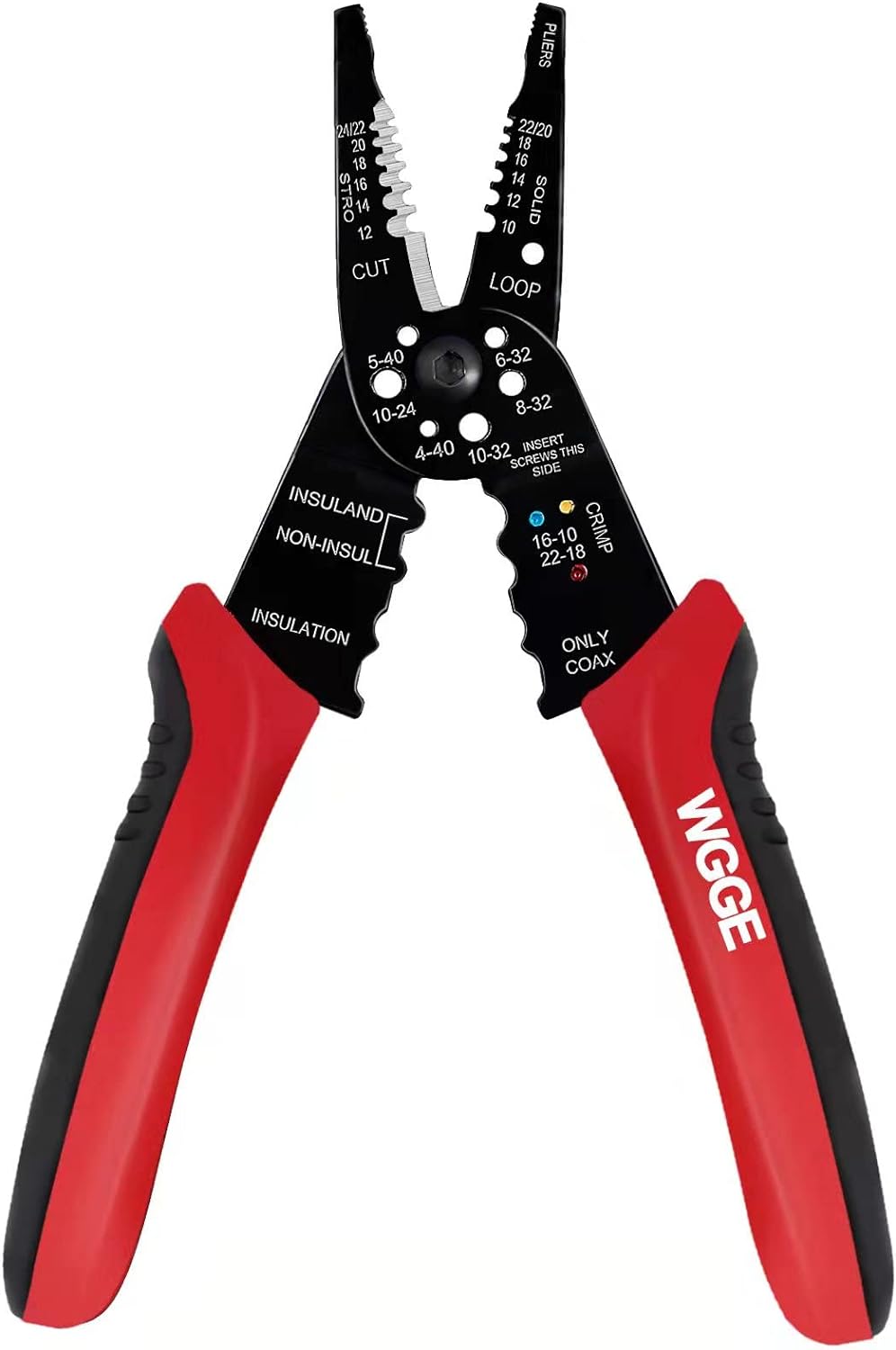
WGGE WG-015 Multi-Function Wire Stripper & Crimper (8-Inch)
An 8-inch stripper, cutter and crimper for 10 to 22 AWG wire, according to the listing.

12 V 150 A Marine Bus Bar Power Distribution Block (1/4" Stud)
A 12 V bus bar rated at 150 A with 1/4-inch studs, according to the listing, for joining several cables at one point. Fuse each circuit as the calculator suggests.
As an Amazon Associate we earn from qualifying purchases at no additional cost to you.
Frequently asked questions
Why is voltage drop much more dangerous in 12 V DC than 120 V/230 V AC? ▼
A 1.2 V drop on a 120 V household line is an insignificant 1% reduction. However, on a 12 V battery system, a 1.2 V drop represents a massive 10% loss. This triggers low-voltage disconnects on 12 V refrigerators, causes LiFePO4 battery monitoring errors, and produces dangerous heat in undersized wires.
What is the difference between one-way distance and total circuit loop length? ▼
Direct current requires electricity to flow from the battery positive terminal to the load and return via the negative cable to the battery. A physical run of 4 meters requires 8 meters of total wire. This calculator takes your one-way distance and automatically multiplies by 2 to compute the true electrical loop.
Should I use 3% or 10% allowable voltage drop for van conversions? ▼
The American Boat and Yacht Council (ABYC E-11, for boats) sets a maximum of 3% for critical circuits such as main feeders, bilge blowers, electronics and navigation lights, and 10% for non-critical circuits such as general lighting. There is no single mandatory rule for vans, so many builders borrow those marine limits. Use 1% to 3% for inverters, DC-DC chargers, solar controllers and compressor fridges, and treat 5% to 10% as acceptable only for LED lights or small fans.
Why does the tool recommend a bigger cable than the voltage drop alone requires? ▼
Because the fuse has to protect the cable, not just the appliance. The recommended fuse is 125% of the load current, rounded up, and the cable's derated ampacity must be at least that size. For a 25 A load the fuse is 40 A, so a cable rated only 27 A would be skipped even if its voltage drop is fine. Never install a fuse above the rating of the wire it protects.
Can I use copper-clad aluminum (CCA) cable? ▼
You can, but it needs a larger cross-section for the same drop. CCA has higher DC resistance than copper, and this calculator assumes pure-aluminum resistivity for it, which is why the result above jumps from 10 mm² to 16 mm². CCA also solders and crimps less reliably, so many installers use pure or tinned copper in vehicles and boats.