SSD Lifespan Calculator
Find out how many years your SSD will last from its TBW or DWPD rating, the warranty and your real daily writes, including remaining life from your SMART data
Drive & Usage
At this write rate the drive stays well within its rated endurance for the warranty period
How to use this tool
- Enter the drive capacity, the warranty length and the endurance rating from the spec sheet, as TBW or DWPD.
- Pick a usage profile or type your own daily writes in GB, and choose the workload type if your writes are random-heavy.
- Optionally add the terabytes already written (from SMART data) to see the remaining life.
- Read the estimated years, the multiple of the warranty period, and how much of the rated endurance is used.
Worked example
Take a 1 TB drive rated 600 TBW with a 5-year warranty, used for gaming and creative work (about 60 GB/day), and 100 TB already written. The remaining 500 TB divided by 60 GB per day is about 8,333 days, or 22.8 years: 4.6 times the warranty period, with 16.7% of the rated endurance already used. The result is a planning figure. Rated endurance is the manufacturer's warranty limit, not a failure date, and real drives often outlast it, but heavy random writes lower the usable margin, which is what the workload multiplier is for.
Methodology
SSD wear comes from writes, never from reads: each program/erase cycle uses up a little of the NAND flash cells' life, so manufacturers publish endurance as a total volume of host data written. All figures here use decimal units (1 TB = 1,000 GB), the way drive makers state their ratings.
How long a 600 TBW drive lasts for five different writers
| Usage profile | Daily writes | Life as rated (×1.0) | Life with mixed random writes (×1.5) | Rated endurance used by end of 5-year warranty (×1.0) |
|---|---|---|---|---|
| Light | 10 GB/day | 100+ years | 100+ years | 3% |
| Everyday | 30 GB/day | 54.8 years | 36.5 years | 9% |
| Gaming & creative | 60 GB/day | 27.4 years | 18.3 years | 18% |
| Video & development | 150 GB/day | 11.0 years | 7.3 years | 46% |
| Heavy workstation | 400 GB/day | 4.1 years | 2.7 years | 100% |
Every row assumes a 1 TB drive rated 600 TBW with a 5-year warranty and nothing written yet. Lifespan is 600,000 GB ÷ (daily writes × workload factor × 365). The last column shows why the heaviest profile is flagged: at 400 GB a day the rated figure is exhausted in 4.1 years, before the warranty ends, so the bar is capped at 100%. A rating is the manufacturer’s warranty limit, not a failure date, and drives can also fail for reasons unrelated to wear, so back up what matters.
SSD Upgrade & Protection Essentials
Handy hardware for replacing, cloning and cooling an aging drive

Samsung 990 PRO 2TB Internal NVMe M.2 SSD (PCIe 4.0)
PCIe 4.0 NVMe drive with read speeds up to 7,450 MB/s, a common replacement when a smaller or heavily worn SSD runs low on endurance. Compare its TBW on the spec sheet with the calculator above.
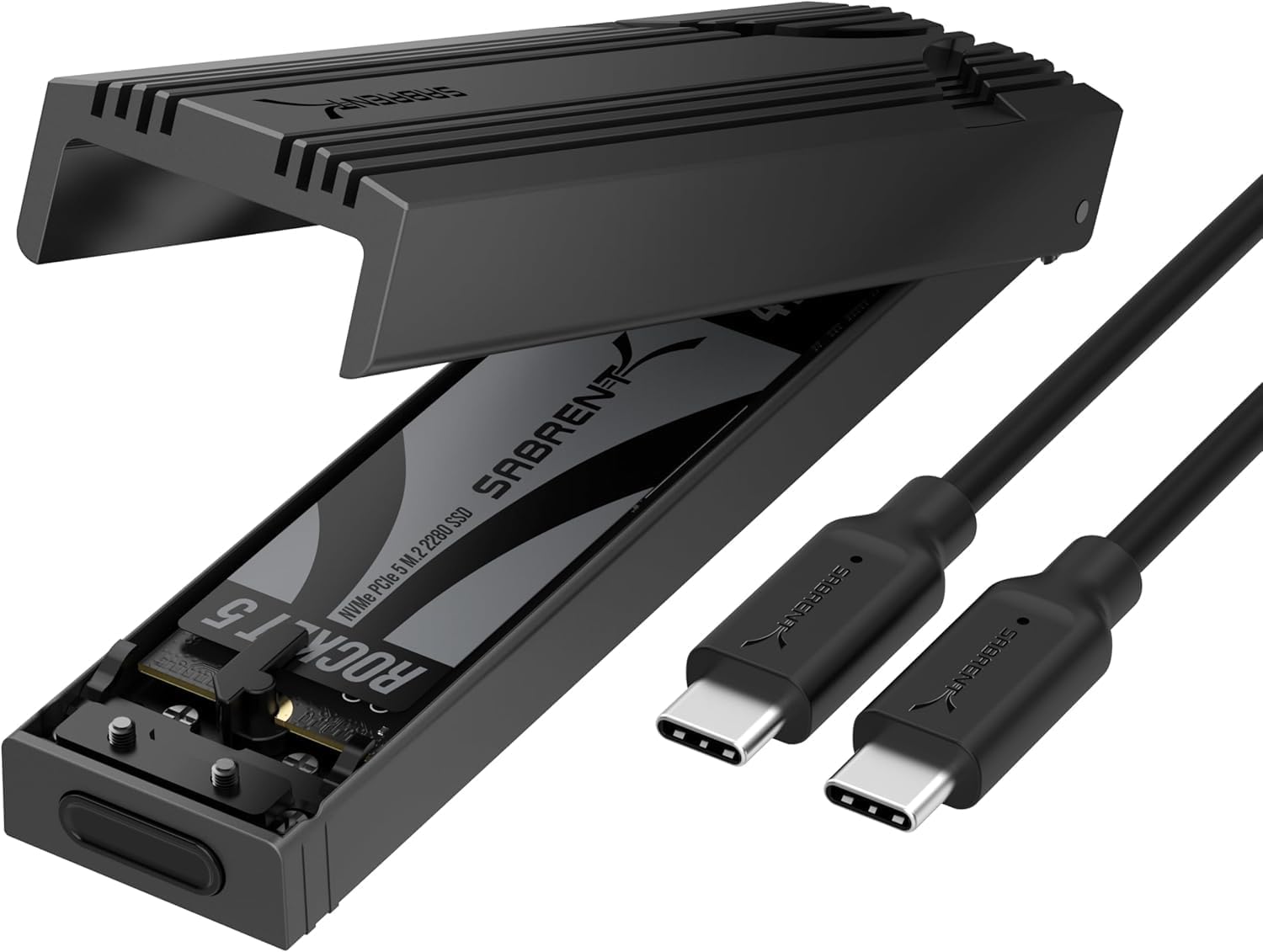
SABRENT USB-C NVMe Enclosure for M.2 SSDs (10Gbps)
Tool-free M.2 NVMe enclosure for 2230 to 2280 drives with USB 3.2 Gen 2 (10Gbps) and aluminum cooling, handy for cloning an aging SSD or reusing it as external storage.

SABRENT M.2 NVMe SSD Heatsink for PS5 (SB-PSHS)
Heatsink made for M.2 NVMe SSDs in the PS5 expansion slot, helping manage temperature under sustained writes. Check clearance before using it in a PC or laptop.
As an Amazon Associate we earn from qualifying purchases at no additional cost to you.
Frequently asked questions
Does my SSD stop working exactly when it reaches its TBW? ▼
No. TBW is the endurance the manufacturer commits to within the warranty, and most warranties end at whichever comes first: the number of years or the TBW. Many drives keep working well beyond it, but the rating is the figure you can rely on, and it is what this calculator uses.
How do I find out how many GB per day my SSD actually writes? ▼
Read the drive's SMART data (for example with CrystalDiskInfo or smartctl) and note Data Units Written (each unit is 512,000 bytes on NVMe) or Total Host Writes. Check it again after a week or two, subtract the two values and divide by the days elapsed.
Why is the DWPD of my SSD so low compared with enterprise drives? ▼
Consumer SSDs are typically rated for roughly 0.3 to 0.6 DWPD over five years because home workloads write far less than that. For example, a 1 TB drive rated 600 TBW over 5 years works out to about 0.33 DWPD, or roughly 329 GB per day. Servers with constant writes need 1 DWPD or more.
Is 30 GB per day a lot of writing for an SSD? ▼
For a typical drive it is small. Thirty GB per day is about 11 TB per year, so a drive rated 600 TBW would take decades to reach its rating at the rated workload. Writes only become a concern with sustained heavy use such as video editing, large databases, virtual machines or constant downloads, which is why the calculator lets you set a workload factor and measure your real daily figure from SMART data.