Headphone Power Calculator
Enter your headphone's impedance and sensitivity to estimate the power (mW) and voltage (Vrms) needed for clean, unclipped output at a target loudness
Enter your headphone's impedance (Ω) and sensitivity, exactly as listed on the manufacturer's spec sheet.
Pick a target loudness. 110 dB covers brief dynamic peaks in music without clipping; typical listening is often around 75–85 dB, and prolonged listening above 85 dB can damage hearing.
Read the required power, voltage, and current, and whether your phone, a dongle, or a dedicated amp is needed.
Headphone Specs
How to use this tool
- Enter the headphone's impedance in ohms and its sensitivity exactly as on the spec sheet, and choose dB/mW or dB/V.
- Set the target loudness with the slider: 90 dB moderate, 110 dB for dynamic peaks, 120 dB extreme.
- Read the required power, voltage and current.
- Compare them with what your phone, dongle or amplifier can deliver.
Worked example
A 300 Ω headphone rated at 100 dB/mW, aimed at 110 dB peaks, needs 10^((110 − 100)/10) = 10 mW, which at 300 Ω is 1.73 V and 5.77 mA. A 32 Ω model with the same sensitivity needs the same 10 mW but only 0.57 V and 17.7 mA. High impedance is therefore a voltage problem, low sensitivity is a power problem. 110 dB is a peak target, not a listening level: prolonged listening above 85 dB can damage hearing, and many people listen at 75–85 dB.
Methodology
Converting an electrical signal into sound pressure relies on Ohm's Law and logarithmic decibel scales. Power requirements scale exponentially as you demand more volume: every extra 10 dB needs 10 times the power, and every extra 3 dB roughly doubles it. Sensitivity figures come from the manufacturer's rated specifications; IEC 60268-7 (Sound system equipment, Part 7: Headphones and earphones) defines how those rated characteristics are specified and measured.
Six headphones at 110 dB, and one surprising comparison
Every row aims at 110 dB peaks with sensitivity in dB/mW. Verdicts use the tool's own limits: easy up to 1 V, 30 mW and 30 mA; moderate up to 2 V, 100 mW and 60 mA.
| Headphone | Power | Voltage / current | Verdict |
|---|---|---|---|
| 16 Ω, 105 dB/mW | 3.16 mW | 0.22 V / 14.06 mA | Easy |
| 32 Ω, 100 dB/mW | 10.0 mW | 0.57 V / 17.68 mA | Easy |
| 80 Ω, 96 dB/mW | 25.1 mW | 1.42 V / 17.72 mA | Moderate |
| 250 Ω, 96 dB/mW | 25.1 mW | 2.51 V / 10.02 mA | Hard |
| 600 Ω, 98 dB/mW | 15.8 mW | 3.08 V / 5.14 mA | Hard |
| 35 Ω, 90 dB/mW | 100 mW | 1.87 V / 53.45 mA | Moderate |
How to read it: the 80 Ω and 250 Ω rows both need 25.1 mW, yet the 250 Ω pair needs 2.51 V instead of 1.42 V. Higher impedance means more voltage and less current, and low sensitivity means more power.
Case: Ana is choosing between pair A (32 Ω, 94 dB/mW) and pair B (150 Ω, 102 dB/mW) for 110 dB peaks, and expects the 150 Ω pair to be the harder one. The tool says otherwise. Pair A needs 10^((110 − 94)/10) = 39.8 mW, which is 1.13 V and 35.27 mA: moderate. Pair B needs only 6.31 mW, 0.97 V and 6.49 mA: easy. The 8 dB sensitivity gap is worth 6.3 times the power. Ana puts B on her shortlist for use straight from a phone and plans a stronger source for A.
These are estimates from rated values, and 110 dB is a peak target, not a listening level.
Recommended Audio Upgrades
A portable DAC, a desktop amplifier and a balanced cable, for when the numbers say your source is not enough
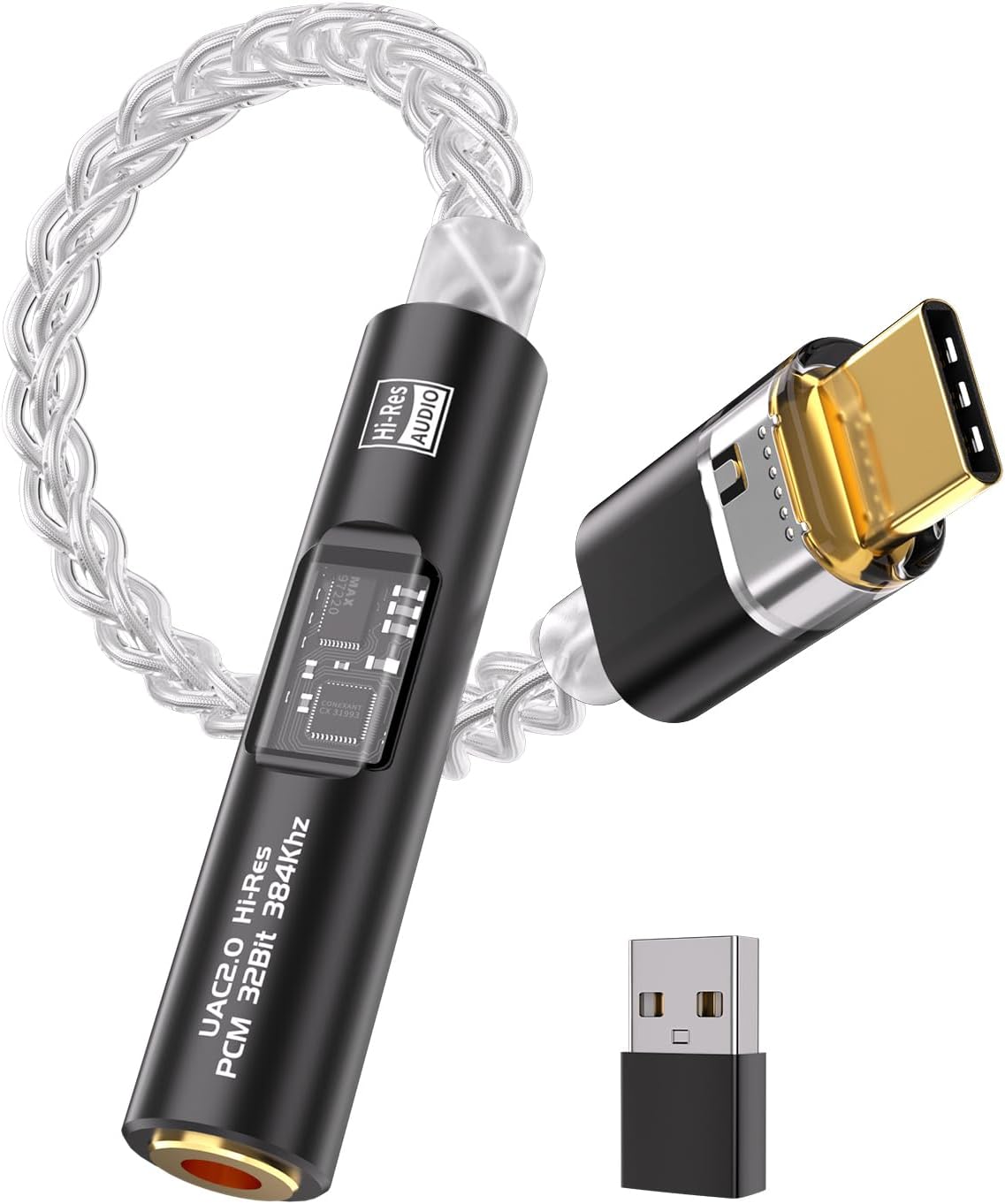
USB-C to 3.5 mm Audio Adapter with CX31993+MAX97220 DAC
A USB-C to 3.5 mm adapter with a built-in DAC, according to the listing, which can replace a phone’s missing headphone jack.

Fosi Audio K5 Pro Gaming DAC & Headphone Amp, 1000 mW
A desktop DAC and headphone amplifier listed at up to 1000 mW, with tone controls. Compare its output with the power the calculator says your headphones need.

Tripowin Zonie 16-Core Silver-Plated IEM Cable
A silver-plated cable for in-ear monitors, according to the listing. A balanced output on many amplifiers gives up to twice the voltage swing.
As an Amazon Associate we earn from qualifying purchases at no additional cost to you.
Frequently asked questions
Why do some low-impedance headphones still need an amplifier? ▼
Impedance isn't the whole story. Sensitivity is often more important. Planar magnetic headphones might have a low impedance (like 35 Ω) but an extremely low sensitivity (like 90 dB/mW). Because they are inefficient, they demand a massive amount of current that standard phone outputs cannot supply.
What happens if I don't give my headphones enough power? ▼
They won't just be quiet; they will sound flat. The bass (which requires the most power to move the driver) will lack impact, dynamics will feel compressed, and turning the volume up will introduce harsh, distorted clipping.
Can I damage my headphones by using an amplifier that is too powerful? ▼
A powerful amplifier is not harmful by itself; it only delivers what the volume setting asks for. The risk is turning the volume up too high. Sustained listening above about 85 dB can cause permanent hearing loss, and headroom is meant for brief peaks, not for your everyday listening level.
Should I pick dB/mW or dB/Vrms in the sensitivity field? ▼
Use whichever unit appears on your headphone's spec sheet, because the two are not interchangeable: 100 dB/mW on a 32 Ω headphone equals about 115 dB/V, so choosing the wrong unit changes the required power by a factor of roughly 30 in this example (about 310 mW instead of 10 mW). If a sheet gives dB/mW at one impedance, do not reuse the number for a different version of the same model with another impedance. The result is an estimate from rated values; real output also depends on the amplifier's own output impedance and fit on your head.