Crop Factor Calculator: Equivalent Focal Length
Pick your sensor and enter a focal length to see the crop factor, what the lens equals on full frame and its angle of view. Or flip it around and find the lens for a framing you want
Your Camera and Lens
Look up the sensor size in your camera’s specifications. For video, use the width and height of the area actually recorded, because many cameras crop further in some modes.
With a zoom lens, enter the focal length you actually use. Equivalence compares framing and depth of field; it is not a verdict on image quality.
Same framing and depth of field as a full-frame camera shot from the same spot. Exposure settings do not change. Angles assume a rectilinear lens focused at infinity.
How to use this tool
- Choose what you want to find, then pick your sensor or enter its width and height in millimeters.
- Enter the focal length of your lens, or the full-frame focal length whose framing you want. Add an f-number if you also want the aperture.
- Read the crop factor, the focal length, the aperture and the angles of view, then press Copy Result.
Worked example
A 35 mm f/1.8 lens on an APS-C sensor of 23.7 × 15.6 mm: the diagonal is 28.37 mm and the crop factor is 1.52. The equivalent focal length is 53.4 mm and the equivalent aperture is f/2.7. The diagonal angle of view is 44.1°, close to the 46.8° of a 50 mm lens on full frame. In the other direction, the framing of a 50 mm full-frame lens needs about 32.8 mm on this sensor.
Methodology
The crop factor compares your sensor with a full-frame sensor of 36 × 24 mm, whose diagonal is 43.27 mm: crop factor = 43.27 ÷ sensor diagonal. Multiplying a focal length by it gives the full-frame focal length with the same diagonal angle of view, and multiplying an f-number by it gives the full-frame aperture with the same depth of field when the framing and the subject distance match. Check with the defaults: an APS-C sensor of 23.7 × 15.6 mm has a diagonal of 28.37 mm, so the crop factor is 1.52, and a 35 mm lens equals 35 × 1.52 = 53.4 mm. At f/1.8 it equals f/2.7.
What crop factor changes and what it does not
The crop factor describes how much of the picture a sensor records, not what the lens is.
- Changes: the angle of view. A 35 mm lens on a sensor with a crop factor of 1.52 frames like a 53.4 mm lens on full frame.
- Changes, when you match the framing from the same spot: the depth of field and the total light the sensor collects. The smaller sensor gives more depth of field, like an f-number 1.52 times higher on full frame.
- Does not change: the real focal length, the f-number marked on the lens and the perspective, which depends only on where you stand.
- Does not change: the exposure for a given f-number, shutter speed and ISO. The picture comes out equally bright.
That is why a 35 mm f/1.8 on this APS-C sensor is described as about 53.4 mm f/2.7 equivalent: a statement about the view and the depth of field, not about a different lens.
Small Extras for the Camera Bag
A lens cleaning kit, a fast SD card and a sling bag for a mirrorless or small DSLR kit
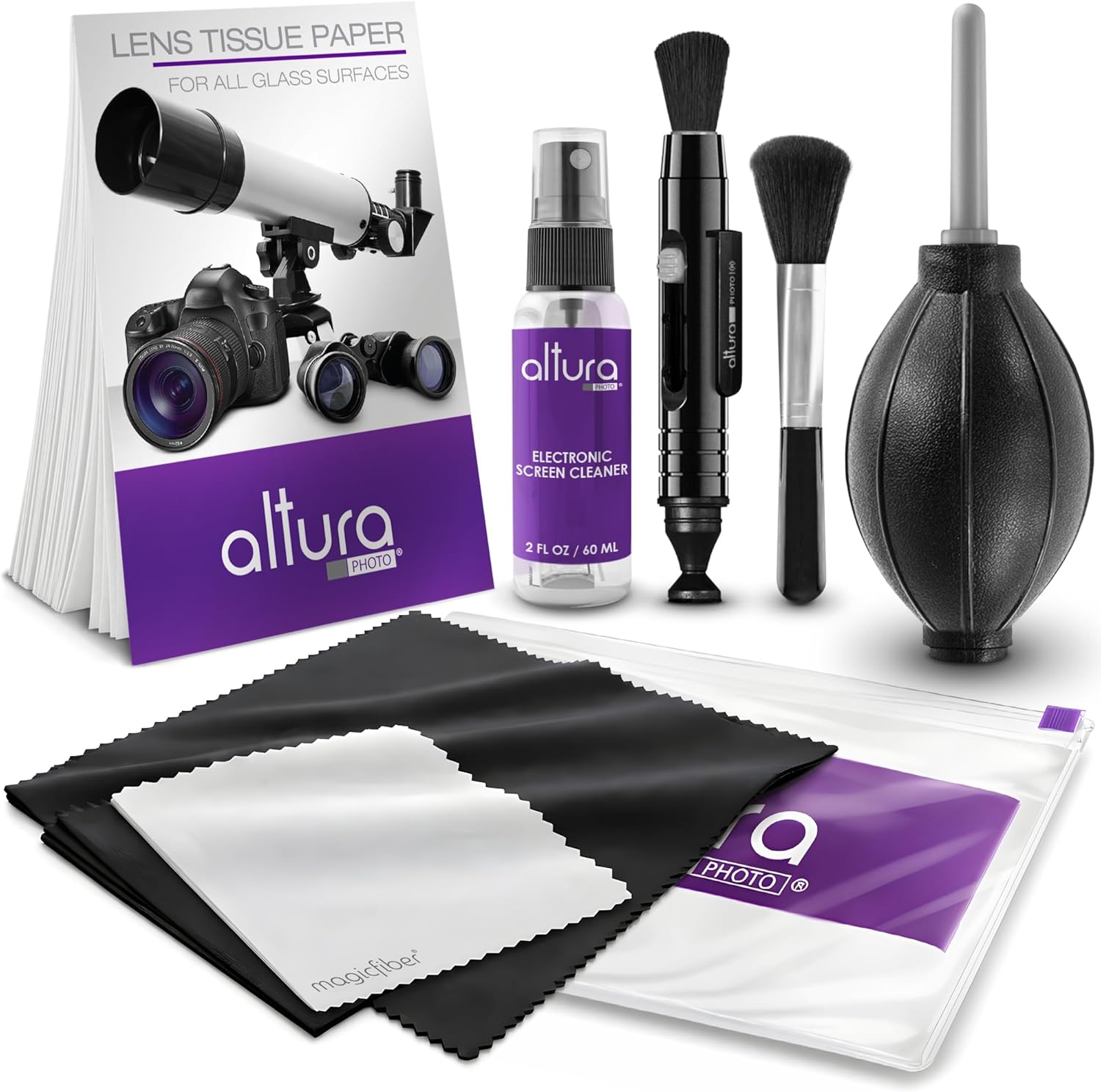
Altura Photo Camera Lens Cleaning Kit, Lens Cleaner for DSLR & Mirrorless
Cleaning kit for DSLR and mirrorless gear, listed as including cleaner, swabs, a pen, a blower, a brush, a cloth and a hard case, to keep lenses and filters clean between shoots.

SanDisk 256GB Extreme PRO SD UHS-I Card, Up to 250MB/s Read and 170MB/s Write, 4K UHD, Full HD, U3, V30
SD card of 256 GB, listed as UHS-I with up to 250 MB/s read and 170 MB/s write speeds, U3 and V30, for 4K UHD and Full HD video. Check that your camera supports this card type.

K&F CONCEPT Camera Sling Bag, Compact Crossbody Backpack, 10L
Compact 10 L crossbody sling bag, listed as fitting a mirrorless camera or a small DSLR, in water-repellent twill with 5 removable dividers and a strap that adjusts from 20.5 to 39.8 in. Check that your camera and lens fit.
As an Amazon Associate we earn from qualifying purchases at no additional cost to you.
Frequently asked questions
What is the crop factor and how is it calculated? ▼
The crop factor compares a sensor with a full-frame sensor of 36 × 24 mm. It is the full-frame diagonal, 43.27 mm, divided by the diagonal of your sensor. An APS-C sensor of 23.7 × 15.6 mm has a diagonal of 28.37 mm, so its crop factor is 1.52. Pick your sensor in the tool, or type its width and height, and the calculator does the division.
Does a crop sensor change the focal length of my lens? ▼
No. A 35 mm lens is 35 mm on every camera. What changes is how much of the image the sensor records, so a smaller sensor shows a narrower view. The equivalent focal length is the full-frame focal length that gives the same view: with a crop factor of 1.52, a 35 mm lens frames like about 53.4 mm. The perspective does not change, because it depends only on where you stand.
Does the crop factor change the aperture and the exposure? ▼
The f-number and the exposure are the same on every sensor: the same f-number, shutter speed and ISO give a similarly bright picture. What differs is the depth of field and the total light collected when you match a full-frame camera’s framing and distance. For that comparison multiply the f-number by the crop factor: f/1.8 on this sensor gives the depth of field of about f/2.7 on full frame. Your lens does not get slower and you do not need to change your exposure settings.
Which lens do I need to get the framing of a full-frame lens? ▼
Switch the first option to the lens you need, enter the full-frame focal length and pick your sensor. The tool divides by the crop factor: for the framing of a 50 mm lens on full frame, this APS-C sensor needs about 32.8 mm. It also shows the aperture that matches the depth of field.
Is anything I enter uploaded? ▼
No. The calculation runs in your browser, so the numbers you type stay on your device and nothing is saved. If you reload or close the page, the fields return to their defaults.