Simple Interest Calculator
Enter the principal, the rate and the time to get the interest and the final amount, or solve for the principal, the rate or the time. Every step is shown with your own numbers
Your numbers
Type plain numbers; a decimal point or comma both work. Rate up to 1,000%, time up to 1,000 years, principal up to 1,000,000,000,000. Your inputs stay in your browser.
Interest = principal × rate × time = 10,000.00 × 6% × 3 = 1,800.00
With the same rate compounded once a year, the final amount would be 11,910.16, which is 110.16 more than the 11,800.00 from simple interest.
| Period | Interest to date | Final amount |
|---|---|---|
| Year 1 | 600.00 | 10,600.00 |
| Year 2 | 1,200.00 | 11,200.00 |
| Year 3 | 1,800.00 | 11,800.00 |
How to use it
- Pick what you want to find: the interest and final amount, the principal, the rate or the time.
- Fill in the other fields. Choose whether the rate is per year or per month, and whether time is in years, months or days. If you count in days, set the days in a year to 365 or 360.
- When you solve for the principal, rate or time, also enter the value you know and say whether it is the interest or the final amount.
- Read the result, the steps with your numbers, the build-up table and the compound comparison. Copy Result keeps the key figures for a message.
Worked example
Principal 10,000.00, rate 6% per year, time 3 years. Interest = 10,000 × 6% × 3 = 1,800.00, so the final amount is 11,800.00. The table adds 600.00 of interest each year (10,600.00, 11,200.00, 11,800.00). With yearly compounding the same figures give 11,910.16, which is 110.16 more. Now reverse it: knowing the interest of 1,800.00, a rate of 6% and 3 years, the principal is 1,800 ÷ (0.06 × 3) = 10,000.00. Counting in days, 90 days at 6% on 10,000 gives 147.95 on a 365-day year and 150.00 on a 360-day year.
Why this tool exists and where its numbers come from
Short loans, notes and some deposits charge interest on the original amount only. The tool uses the textbook formula I = P × r × t and its rearrangements; real contracts may count days differently or compound the interest.
Sources
For the full method, see the Methodology section just below.
Methodology
The formula. Simple interest is charged only on the original principal, so every period adds the same amount: I = P × r × t, where P is the principal, r the rate per year as a decimal and t the time in years. The final amount is A = P + I = P × (1 + r × t). Solving backwards gives P = I ÷ (r × t), r = I ÷ (P × t) and t = I ÷ (P × r); if you know the final amount instead of the interest, I = A − P and P = A ÷ (1 + r × t). The rate and the time must be in the same unit, so the tool converts everything to years first: a monthly rate is multiplied by 12 and months are divided by 12. Days are divided by 365 or 360, as you choose. For example, 5 months at 5% on 1,100 is 1,100 × 0.05 × 5/12 = 22.92, and 294 days at 8% on 4,200 is 4,200 × 0.08 × 294/365 = 270.64; the tool reproduces both worked examples from an open business-math textbook. Compound interest differs because each period's interest is added to the balance: 1,000 at 5% for 2 years gives 1,100.00 with simple interest and 1,102.50 with yearly compounding. The comparison box uses P × (1 + r)n with one compounding per rate period, and applies the same formula to fractional periods.
Sources and documentation
The formula and the same-unit rule come from the first two entries, the simple-versus-compound example from the third, and the day-count conventions from the first, fourth and fifth. Pages were consulted in October 2026. The second to fifth pages are in Portuguese, French, German and Spanish.
- Business Financial Math (eCampusOntario): Simple InterestI = Prt, matching units, a 365-day year, and the worked examples reproduced above.
- ENAP (Brazil): Taxa de Juros (Portuguese)Simple interest j = C × i × n and M = C + j, with rate and period in the same unit.
- INC-Conso with Banque de France: simple vs compound interest (French)1,000 € at 5%: 1,100 € against 1,102.50 € after two years.
- Landesakademie Lehrerfortbildung Baden-Württemberg: Zinsformel (German, PDF)Z = K · p · t with a 360-day year and 30-day months.
- BBVA México: how to calculate simple interest (Spanish)I = C × r × t, with a 360-day basis for daily conversion.
Where Simple Interest Sums Go Wrong
Each slip below was reproduced with the tool, using a principal of 10,000 at 6% per year.
- Mixed units. 18 months is 1.5 years, so the interest is 900.00. Typing 18 as years gives 10,800.00. The time unit selector keeps both on the same footing.
- The day count. 90 days give 147.95 on a 365-day year and 150.00 on a 360-day year. Pick the basis your contract uses.
- A monthly rate read as yearly. 1.5% per month for 8 months is 1,200.00; read as 1.5% per year it is 100.00. The rate period selector prevents it, and the steps show the yearly rate.
- Percent as a decimal. Typing 0.06 instead of 6 returns 18.00 instead of 1,800.00, because the field is already in percent.
- Interest taken as the total. 1,800.00 is only the interest; the amount to pay back or collect is 11,800.00. The tool shows both.
Estimate for information only, not financial advice.
Tools for Checking the Math
A calculator on the desk and a refresher on the page, for working problems out by hand
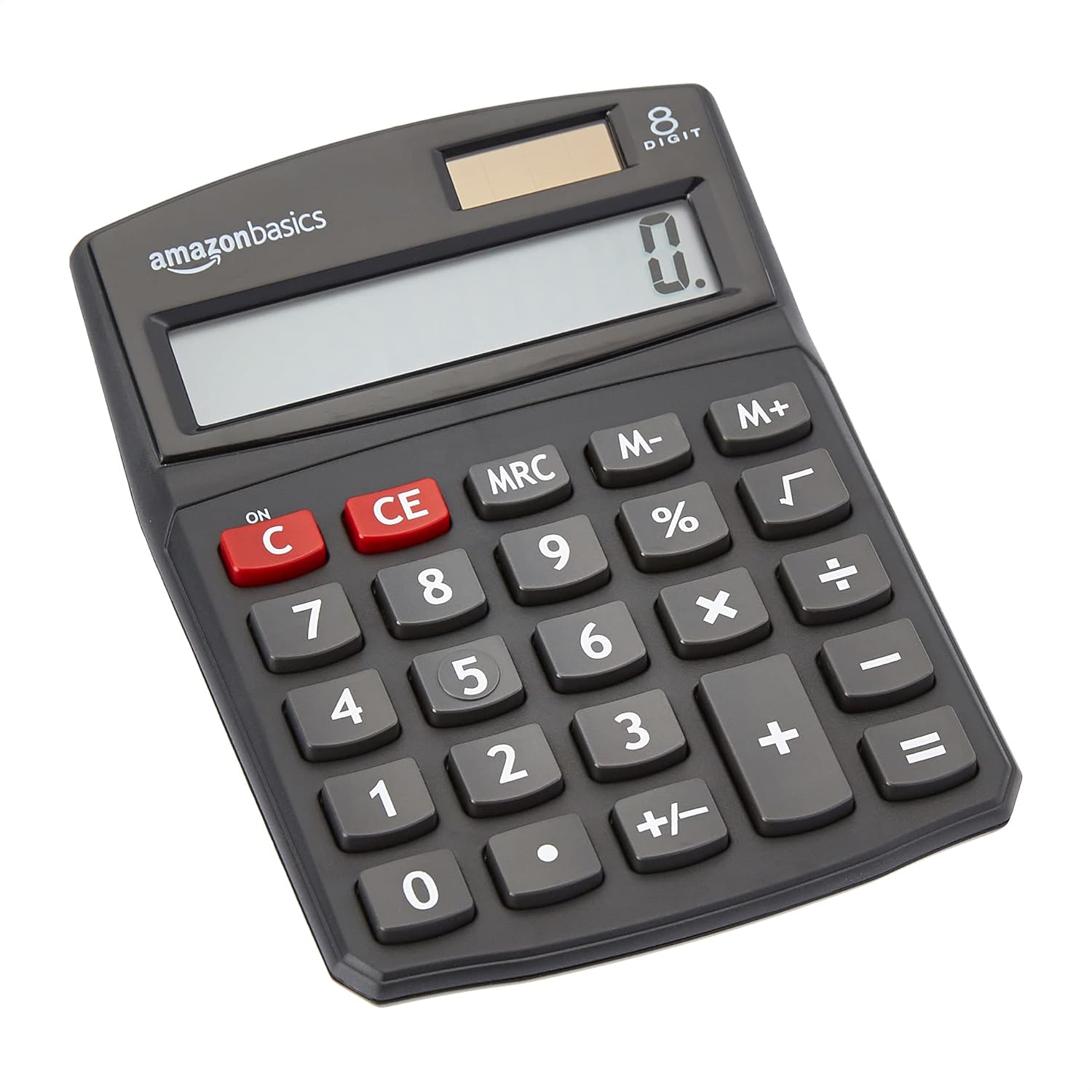
Amazon Basics LCD 8-digit desktop calculator, portable, black
A basic 8-digit LCD desk calculator in black, according to the listing; enough to check interest sums by hand.

BA II Plus financial calculator
Listed as a financial calculator, for anyone who wants to cross-check results that go beyond simple interest.
As an Amazon Associate we earn from qualifying purchases at no additional cost to you.
Frequently asked questions
What is the difference between simple and compound interest? ▼
Simple interest is always calculated on the original principal, so it grows by the same amount each period. Compound interest is also calculated on the interest already added, so it grows faster. With 1,000 at 5% for 2 years, simple interest gives 1,100.00 and yearly compounding gives 1,102.50. The comparison box shows the gap for your own numbers.
Should I use 365 or 360 days in a year? ▼
Use the one your contract, bank or textbook states. 365 counts actual days; 360 is a commercial year with months of 30 days. For 90 days at 6% on 10,000 the interest is 147.95 with 365 and 150.00 with 360. When time is entered in years or whole months, the choice makes no difference.
How do I find the rate, the time or the principal if I know the interest? ▼
Choose what to solve for, enter the other values and the known interest or final amount. The tool rearranges the formula: rate = interest ÷ (principal × time), time = interest ÷ (principal × rate) and principal = interest ÷ (rate × time). For example, 1,800 of interest on 10,000 over 3 years is a rate of 6% per year.
Does the result include fees, taxes or inflation? ▼
No. It is the plain simple-interest arithmetic on the numbers you enter. Real loans and savings products may add fees, tax, compounding or a different day count, so treat the result as an estimate for information and check the contract or ask the provider. This is not financial advice.